
Localisation Best Practices Conference – localisation in game development and distribution
On 24 November 2022, locatheart organised the first conference in Poland dedicated entirely to game localisation – the Localisation Best Practices Conference (LBPC). Bringing together experts from translation agencies and game development studios, the event explored how localisation helps games reach and connect with players around the world.
With three keynote talks and a panel discussion, the programme covered the challenges of mobile game translation, the localisation of major game worlds such as The Witcher and Cyberpunk 2077, and the keys to successful localisation, from development and LQA to distribution.
From practical advice to behind-the-scenes insights, here’s what stood out at the first edition of the Localisation Best Practices Conference.
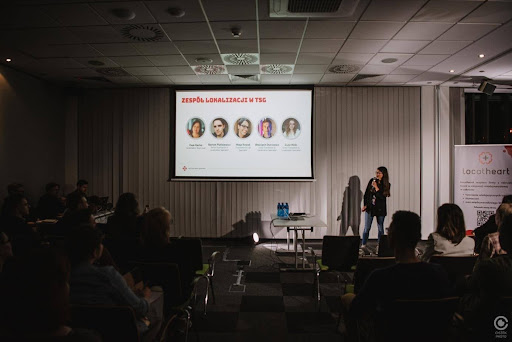
LQA in the dynamic environment of mobile game development – Maja Kosioł, Ten Square Games
Have you ever deleted an app because of a spelling mistake? Maja Kosioł has. As a member of the localisation team at Ten Square Games, where she handles LQA, she knows how much localisation quality can shape a player’s experience.
She kicked off her presentation with a story about downloading an educational game for her daughter. They’d barely finished the tutorial when Kosioł noticed a typo. Her first instinct was to take a screenshot, followed by uninstalling the app. After all, why pay for a game that doesn’t even get its welcome screen right when there are so many alternatives out there?
This little anecdote set the scene for her talk about localisation quality assurance (LQA) and its role in mobile game development. Poor-quality content, she explained, can frustrate players, undermine their experience, and even put them off spending money in a game.
One of the biggest challenges is the speed at which mobile games evolve. With regular updates, seasonal events, special offers, and daily push notifications, localisation teams constantly have new content to work on, often under tight deadlines. This is particularly true for products following the Games as a Service (GaaS) model, where keeping players engaged depends on giving them fresh content on a regular basis.
Credit: Ciszek Photo
Kosioł pointed to examples from Ten Square Games’ hit title Fishing Clash to show how unclear translations can leave players struggling to understand in-game events. She also mentioned KFC’s 2022 notification scandal in Germany, when an automated promotional message coincided with the anniversary of Kristallnacht – a reminder of what can happen when no one checks whether automated content makes sense in its cultural context.
So how can localisation teams avoid similar problems? Kosioł offered a few practical steps: get involved in development early, build strong relationships with other teams, and keep communication open.
She also stressed the importance of using data to guide decisions. When deadlines are tight and teams are handling dozens of languages, knowing which markets bring in the most players and revenue can help them set priorities.
Her message was clear: localisation quality should be part of the conversation from day one.
3 pillars of successful localisation, or how to win the hearts of gamers around the world – Kamila Puzdrowska, locatheart
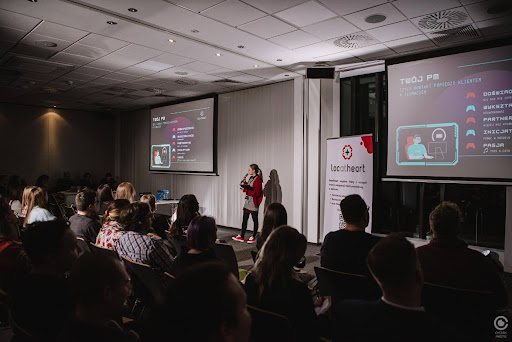
What makes a game feel like it was made for players in every market? For Kamila Puzdrowska, Senior Project Coordinator at locatheart, it comes down to three pillars: the right people, tools, and processes. In her presentation, she offered a behind-the-scenes look at game localisation, using practical examples from her day-to-day work.
It all starts with people. Project managers connect clients with linguists, keep the work on track, and make sure everyone has the information they need. Their role can go beyond coordination, too: a reliable localisation partner will flag problems in the source text and help clients improve their workflow. Then there are the linguists. Puzdrowska stressed the value of working with native speakers who understand the target culture and, ideally, love games themselves. One example she shared was a Brazilian Portuguese translator who noticed that a July game event referred to summer holidays. That wouldn’t ring true for Brazilian players, since July is winter there. It’s a small adjustment, but it can make a world of difference.
Credit: Ciszek Photo
The second pillar is the technology. Translation memories, glossaries, and CAT tools help teams work consistently and save time. Extra LQA tools and a second set of eyes can also catch typos, terminology problems, and inconsistencies between different versions of the same content. As Puzdrowska put it, there’s no need to drive a nail with your fist when you can use a hammer.
Finally, there’s the process itself. Clear instructions and helpful reference materials can make a real difference for translators. Puzdrowska also shared the team’s query sheet: a collaborative online document where linguists, project managers, and clients can ask questions and share information. Since the team works across time zones, someone in South Korea can answer a question from Japan before the Polish team even starts its day.
Of course, localisation projects don’t always go to plan. New languages, last-minute changes, missing information, and unexpected deadlines are all part of the job. As Puzdrowska noted, the key is being ready to adapt. Great localisation depends on processes flexible enough to handle whatever comes along.
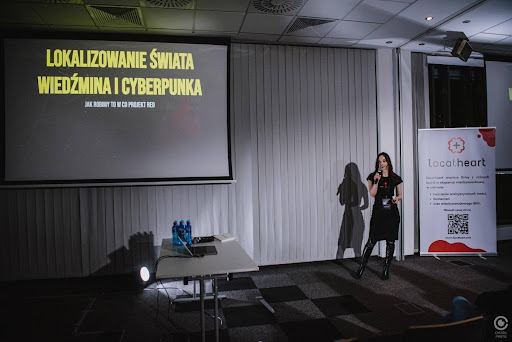
Localising the world of The Witcher and Cyberpunk – Wiktoria Paciorek, CD PROJEKT RED
How do you make sure players around the world feel the same emotions when they play a game in different languages? It’s one of the biggest challenges for the localisation team at CD PROJEKT RED, the studio behind The Witcher and Cyberpunk 2077. Wiktoria Paciorek, who works on the studio’s localisation team, gave us a fascinating glimpse behind the scenes of adapting these worlds for players everywhere.
Both games are massive open-world adventures, filled with amazing stories, memorable characters, humour, and cultural references. The aim is to make each language version feel as authentic and emotionally powerful as the original. That takes a lot of time: localisation for The Witcher 3 took an estimated 17 months, while Cyberpunk 2077 took around 20 (as of the date of the conference, the games had been released in 17 and 18 languages, respectively).
The studio’s localisation team includes English adaptation, project management, and localisation QA specialists. They work closely with translators, testers, and dubbing studios across the globe. Native speakers who understand their local cultures are vital, particularly when adapting slang, internet references, and pop-culture jokes.
Credit: Ciszek Photo
She also emphasised that localisation extends well beyond words. Even something as simple as how time is displayed can vary from one market to another. And languages like Arabic, which are read from right to left, can require changes across the entire interface. Text length matters too: a German translation may be spot-on, but it won’t help much if it doesn’t fit in the game’s menu.
So, is all that extra work and investment worth it? For CD PROJEKT RED, absolutely. Paciorek recalled the excitement among Chinese players when the studio announced Chinese voice-over for The Witcher 3 – the news drew 5.7 million responses on Weibo. It’s a powerful reminder of how much players value experiencing a game in their own language. Paciorek’s closing thought captured it perfectly: localisation is an art, and a vital part of game development. It helps bring stories, characters, and emotions to life for players around the world.
Credit: Ciszek Photo
Panel discussion: the role of localisation in game development and distribution
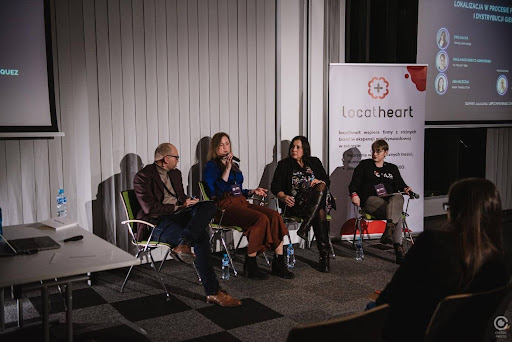
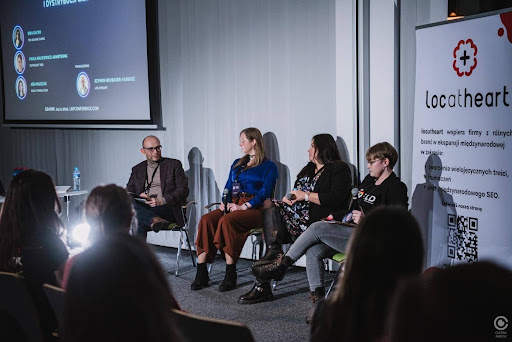
Hosted by locatheart CEO Szymon Neubauer-Vasquez, the panel featured three experts in game localisation: Asia Mleczak from Mana Translation, Ewa Dacko from Ten Square Games, and Paula Mackiewicz-Armstrong from CD PROJEKT RED. They discussed the role of localisation in game development and marketing, the challenges of adapting games for different markets, and why it’s important to acknowledge the people who bring localised versions to life.
A key takeaway was that localisation belongs at the heart of game development, not as a final quality-assurance step. Dacko said it has more in common with UX design than end-stage testing, since both focus on making the experience accessible and enjoyable for players. Mackiewicz-Armstrong explained that, because CD PROJEKT RED’s games are originally written in Polish, the English adaptation is developed alongside the Polish version. Adaptation specialists work closely with writers and quest designers, and scripts include contextual notes and comments to help translators and voice actors better understand the scenes, characters, and dialogue.
The panellists also highlighted the importance of preparation, context, and communication. Translators need more than strings in isolation: they need scripts, dialogue trees, character details, and information about how the text will appear in the game. Mleczak recalled a project where translators received only strings in alphabetical order. When they asked for more context, the client – citing their confidentiality policy – sent non-editable JPG files instead. It took four months of negotiation before the client agreed to localisation quality assurance. By contrast, she described another project with a carefully prepared script that even conveyed characters’ emotions, despite there being no voiceover. That context helped translators create a natural Polish narrative. The examples illustrated how much the quality of the final experience depends on the information and support provided by developers.
Credit: Ciszek Photo
Technical decisions also need to take language into account. A solution built for English won’t necessarily work well in other languages. Mleczak pointed to Polish grammar as an example: automated systems that use tags to match adjectives with nouns can run into trouble because grammatical forms change depending on context. If these issues aren’t tested until a few months before launch, there may not be enough time or budget to fix them – and some language versions may not be released at all. The panellists also stressed the importance of considering UI design, fonts, and right-to-left text support for languages such as Arabic.
Another especially interesting topic was the connection between localisation and marketing. Game localisation involves far more than translating in-game content. Descriptions, social media posts, blog posts, press releases, ads, and community communications all help connect with players. Dacko observed that localisation choices are also marketing choices, and that marketing data can help identify which markets are worth pursuing. Even markets that bring in relatively little direct revenue can attract large numbers of players and encourage strong engagement. Mackiewicz-Armstrong added that releasing content in less commonly supported languages can help build close-knit communities. She pointed to the Creole voiceover in Cyberpunk 2077, which helped players feel represented in the game world.
The panellists stressed that each market comes with its own linguistic, cultural, and legal challenges. Polish grammar can trip up automated text systems and make character limits harder to manage, while games from Asian markets may include cultural references that Polish players aren’t familiar with. The reverse is also true: Slavic folklore in The Witcher had to be carefully adapted for Japanese, Chinese, and Korean audiences. Korea, Japan, and Scandinavia stood out as especially demanding markets when it comes to language quality. Even if the wording is technically correct, anything that sounds unnatural can put players off. Polish players, meanwhile, expect a high standard of storytelling and dubbing.
The panel also discussed the visibility and recognition of localisation professionals. Translators aren’t always credited, and localisation teams can end up taking the blame for decisions they had little or no say in. The panellists called for a better understanding of how localisation works, along with greater recognition for the people behind it.
One message came through clearly: successful localisation depends on getting teams involved early, planning carefully across both creative and technical work, and understanding each target market. When localisation is done right, players may barely notice it. When it isn’t, they certainly will.
A big thank you to our speakers, panellists, and everyone who joined us for the first Localisation Best Practices Conference. We hope it will spark further conversations and help great games feel at home around the world!
Watch the full conference below:




Leave a Reply